
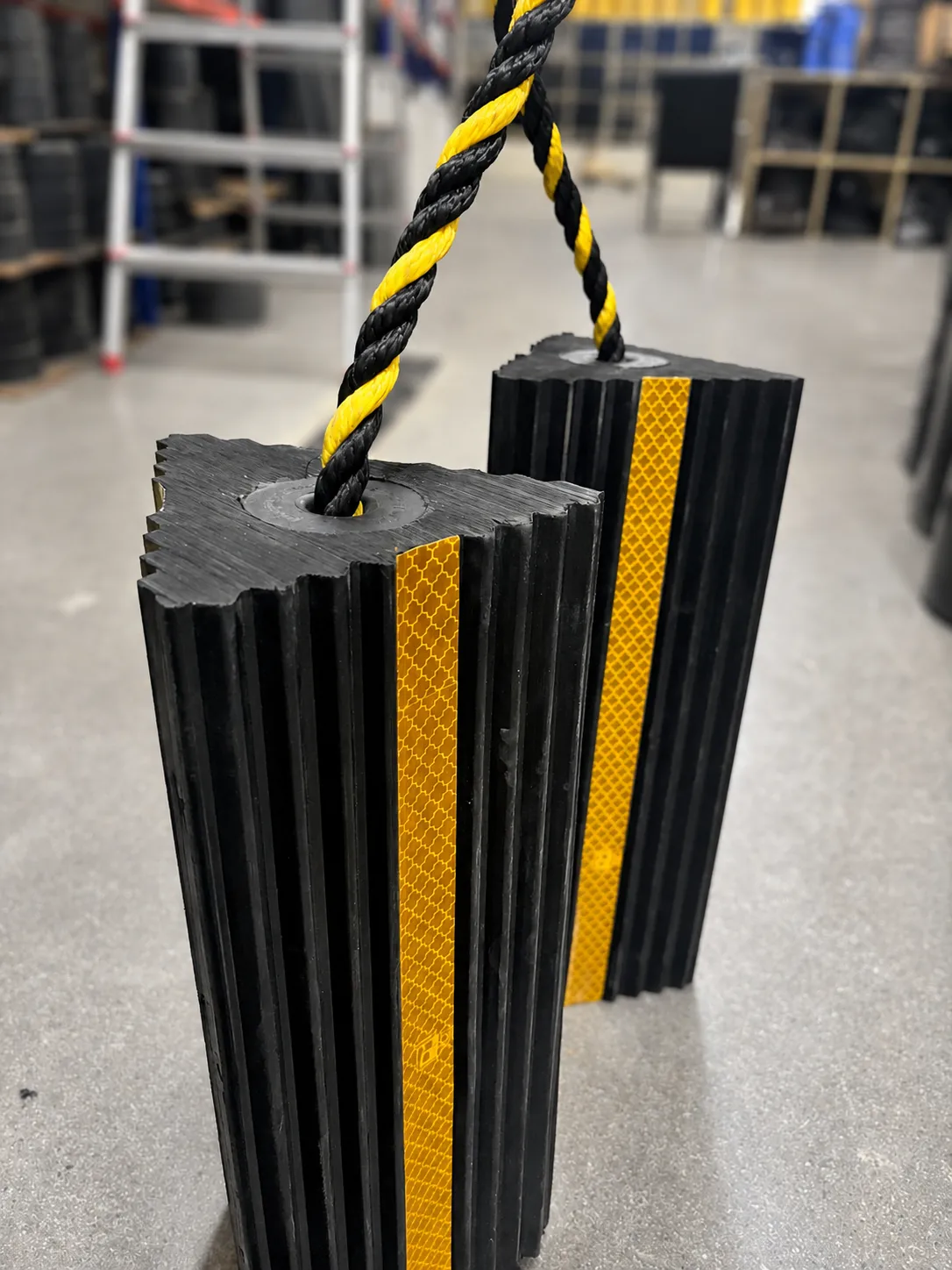
In aviation ground operations, wheel chocks are often treated as simple, low-priority accessories. In reality, they are safety-critical components. On a busy apron, an undersized or poorly engineered chock can quickly become a costly liability. If the material deforms under heavy load, loses grip on wet asphalt, or fails to engage properly with the tyre profile, the consequences can range from expensive airframe damage to severe operational risks for the ground crew.
For airports, Fixed-Base Operators (FBOs), Maintenance, Repair, and Overhaul (MRO) facilities, and ground handling teams, generic products rarely offer a dependable, long-term solution. A compact business jet parked on a tight corporate stand presents completely different physical requirements from a massive, fully loaded cargo aircraft sitting on a rain-soaked winter apron. Treating both scenarios with the same standard wheel chock simply does not make engineering sense.
This is where properly sized, application-specific custom aircraft chocks prove their ultimate value.
Why Generic Aircraft Chocks Often Underperform
Many standard wheel chocks on the market are produced with lightweight hollow interiors or generic “universal” dimensions intended to suit every aircraft category. In practice, this cost-cutting approach introduces critical operational weaknesses:
- Insufficient Contact Area: Standard shapes fail to hug the tread of larger commercial or military aircraft tyres properly.
- Structural Fatigue: Hollow designs experience internal collapse or permanent deformation under sustained static loads.
- Reduced Grip: Generic rubber compounds harden in the cold, causing the chock to slip on wet, icy, or fuel-contaminated apron surfaces.
- Poor Clearance Compatibility: Standard heights can interfere with the low-clearance fairings or landing gear geometry of modern private aircraft.
Without the correct balance of Shore A hardness, compressive strength, physics-optimised profile geometry, and anti-slip design, wheel chocks become cheap consumables rather than dependable safety equipment.
Technical Specifications: Sizing for Operational Demands
Effective chocking starts with matching the equipment to the physical dimensions of the aircraft fleet. Below is a technical breakdown of how professional solid rubber wheel chocks are categorized based on actual operational applications, drawing from standard international aviation dimensions:
Aviation Wheel Chock Sizing Matrix
| Product Class | Standard Profile Dimensions (A x B) | Recommended Length (C) | Primary Fleet Applications |
| Compact / Low Profile | 100 x 100 mm | 250 mm | Small / Business Jets, Private Aviation fleets |
| Standard / General | 160 x 160 mm | 450 mm to 600 mm | Light Training Aircraft, General Purpose Hangars |
| Medium / Regional | 170 x 200 mm | 500 mm | Regional Jets, Mid-size Commercial Fleets |
| Large / Wide-body | 160 x 160 mm | 900 mm | Wide-body Passenger Fleets, Heavy Cargo Aircraft |
| Heavy-Duty / Commercial | 230 x 230 mm | 450 mm | Heavy Commercial Aircraft, High-Load Aprons |
Low Profile Applications: Business Jets and Compact Needs
Aircraft such as business jets, light training planes, regional fleets, and ground support vehicles often operate with highly restricted wheel clearance and limited airside storage space. In these tight environments, oversized chocks become awkward to position manually and can easily damage landing gear sensors or low fairings.
For these specific operations, compact low-profile units (such as the 100×100 mm configuration) offer significant practical advantages:
- Ergonomic Handling: Faster, safer manual deployment and retrieval during high-pressure turnaround windows.
- Optimised Geometry: Secure wheel engagement without excessive height, mitigating clearance risks.
- Solid Rubber Core Performance: Despite their smaller dimensions, professional low-profile chocks maintain a 100% solid core. Unlike hollow alternatives, they offer full load-bearing capacity without internal collapse over years of service.
Wide-Body Operations: Heavy-Duty Commercial Demands
Heavy commercial aviation introduces a completely different set of engineering demands. Wide-body passenger aircraft, international cargo fleets, and military transport platforms generate massive static and dynamic wheel loads that instantly crush lower-grade ground equipment.
To resist these forces, heavy-duty rubber wheel chocks utilize massive profiles reaching up to 230×230 mm. Designed for heavy maintenance facilities and long-haul parking positions, their structural integrity relies on two core pillars:
Material Performance Sheet
| Technical Feature | Engineering Benefit | Operational Impact |
| All-Weather Compound | Reliable thermal stability from $-40^\circ\text{C}$ to $+120^\circ\text{C}$ | Prevents freezing/cracking in Nordic climates and melting/softening in Middle Eastern heat. |
| Physics-Optimised Triangle | Maximises total contact area between tyre tread and apron floor | Evenly distributes heavy force, preventing the chock from rolling or sliding. |
| Ribbed Anti-Slip Grooves | High-friction mechanical grip on smooth or contaminated concrete | Maintains dependable traction even in rain, snow, and de-icing fluids. |
| Chemical & UV Resistance | Chemical immunity to jet fuel, hydraulic oils, and intense ozone exposure | Eliminates surface cracking, significantly extending product lifespan. |
For airport operators and procurement managers, investing in these high-resistance solid rubber specifications drastically reduces repeated replacement cycles, warehouse stockholding requirements, and unnecessary exposure to avoidable airside safety risks.
Reflective Aviation Chocks: Improving Ramp Visibility
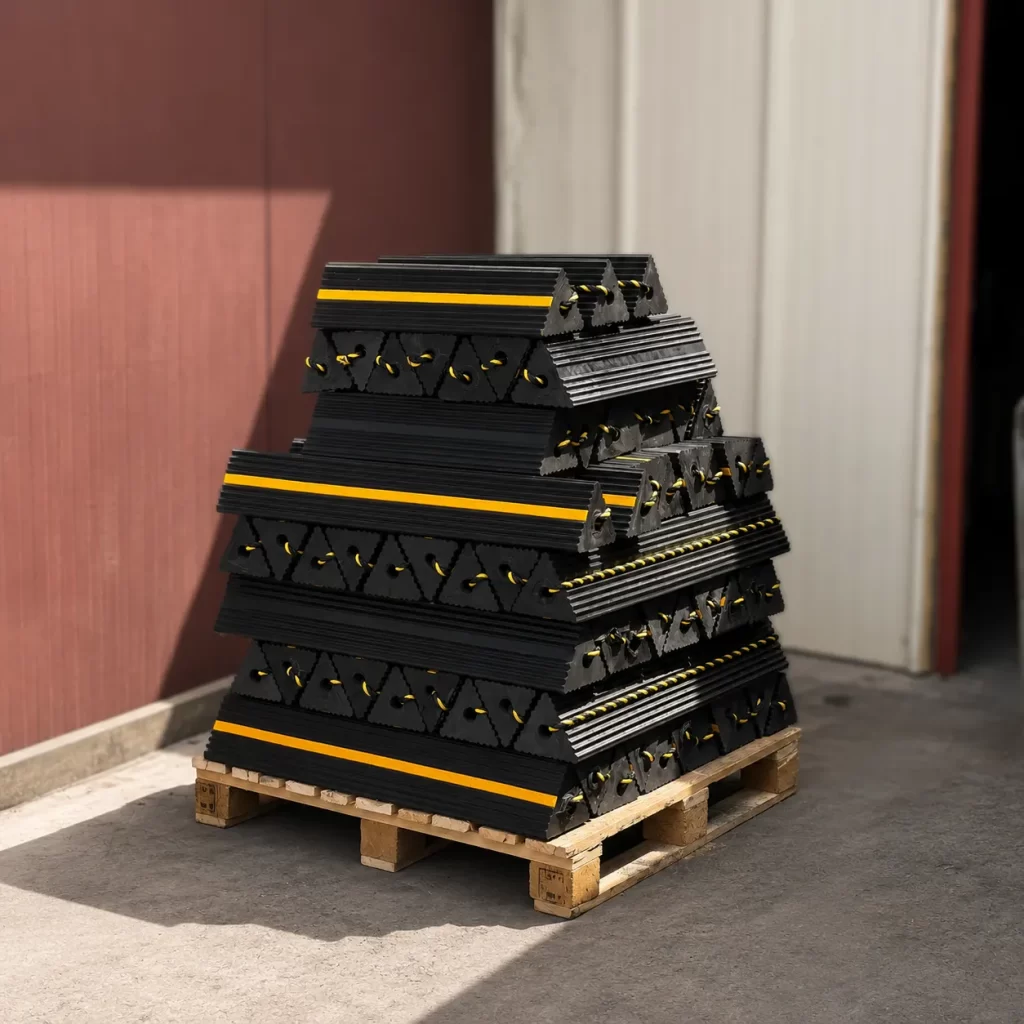
Visibility remains a core element of airside safety compliance, particularly during night turnarounds, winter storms, or busy ground handling periods.
Modern high-performance chocks incorporate integrated high-visibility amber reflective strips. This small engineering detail provides massive operational benefits:
- Accident Mitigation: Drastically reduces the likelihood of baggage tractors or ramp vehicles accidentally striking misplaced equipment.
- Faster Turnarounds: Allows ground crews and flight captains to instantly verify that the aircraft is safely secured during walk-arounds, even in low-light conditions.
- Procedural Compliance: Helps ground operations managers monitor apron safety procedures from a distance.
Strategic Sourcing: Custom Manufacturing from Rubbersan
In aviation procurement, focusing solely on the lowest initial unit price is rarely economical. Low-grade, hollow wheel chocks fail prematurely, leading to frequent re-ordering cycles, operational delays, and heightened safety exposure. True cost efficiency is found by looking at the total cost of ownership over time.
As an experienced international manufacturer of aviation ground support equipment, Rubbersan engineers premium safety solutions from its manufacturing base in Istanbul, Turkey. Combining advanced industrial rubber production with competitive export logistics to European, Middle Eastern, and global markets, Rubbersan delivers fleet-specific customisation directly to B2B clients.
Available Fleet Customisation Options:
- Tailored Product Dimensions: From compact business jet chocks (Model
JT1025) to massive wide-body cargo options (ModelUT1690). - Bespoke Compound Engineering: Shore A hardness adjustments and specific weather or oil-resistant formulations to match your local climate.
- Operational Configurations: Integrated heavy-duty rope handles or chain assemblies for easy retrieval, custom colors, and reflective marking specifications.
- Wholesale B2B Supply: Factory-direct pallet stock ready for rapid international logistics, supporting airlines, major airport hubs, and global MRO chains.
Investing in application-specific ground equipment is not an unnecessary luxury—it is the foundation of flawless airside safety and operational resilience.
Contact Rubbersan’s engineering team today to review your fleet’s dimensional requirements, request technical datasheets, or secure a wholesale procurement quotation.