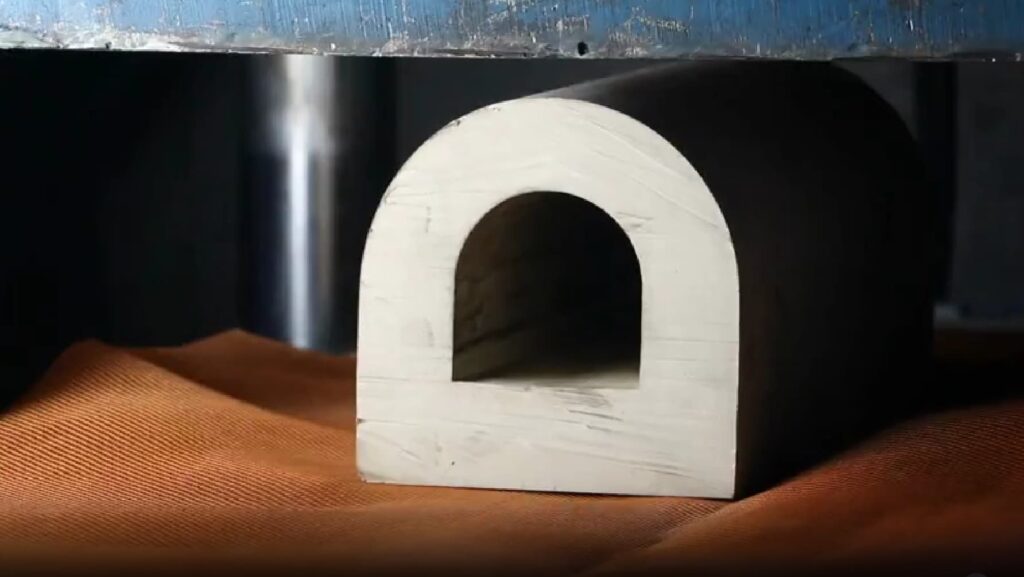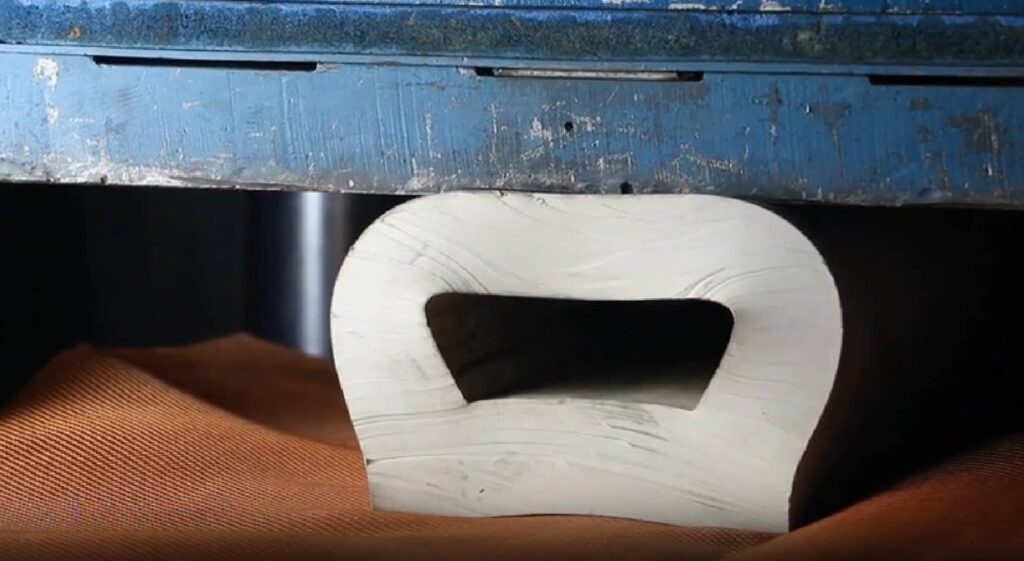
The D-type rubber fender is a high-performance extruded profile engineered specifically for marine and harbour infrastructure. Featuring a solid square outer section and a hollow D-shaped inner chamber, it provides exceptional impact absorption. Manufactured from a premium SBR rubber compound, this series maintains its elasticity and structural strength in demanding environmental conditions ranging from -30°C to +110°C.
During vessel contact, the internal D-chamber dampens impact energy in a controlled manner, protecting both the vessel hull and the quay structure from potential damage.
Designed for versatile applications, this series is available in widths from 60 mm to 300 mm. It offers direct installation options for both light-duty marina fender profiles and heavy-tonnage ship berthing fenders in commercial ports.
Applications
- Marinas and Yacht Harbours: Flexible protective edging along floating pontoons and jetties.
- Ports and Quay Structures: High-energy impact absorption for commercial ships, barges, and tugboats.
- Tugs and Workboats: Wear-resistant protective barriers around boat hulls.
- Industrial Loading Bays: Vehicle and ramp bumper protection at logistics centres.
- Bridge Piers and Marine Structures: Protective quay rubber shock absorber coverings for submerged concrete structures.
Key Features and Technical Advantages
- Optimised Geometry: Square cross-section (A x A) combined with a hollow D-core that progressively distributes impact energy.
- Wide Operating Range: Stable mechanical performance between -30°C and +110°C.
- Weather and Wear Resistance: Outstanding resistance to water, weathering, and UV exposure.
- Ozone Crack Resistance: Homogeneous, crack-resistant composition compliant with ISO 1431-1 Method A.
- Chemical Resistance: Moderate-to-high resistance to diluted acids, alkalis, and oily marine environments.
Custom Manufacturing and Fabrication Options
All D-type rubber fender profiles can be tailored in-factory to suit your exact installation and project requirements:
- Custom Length Cutting: In addition to standard lengths, profiles are cut to exact project specifications with precise tolerances. For custom lengths, the suffix “CST” is added to the SKU (e.g. RS-FND-D-100-CST).
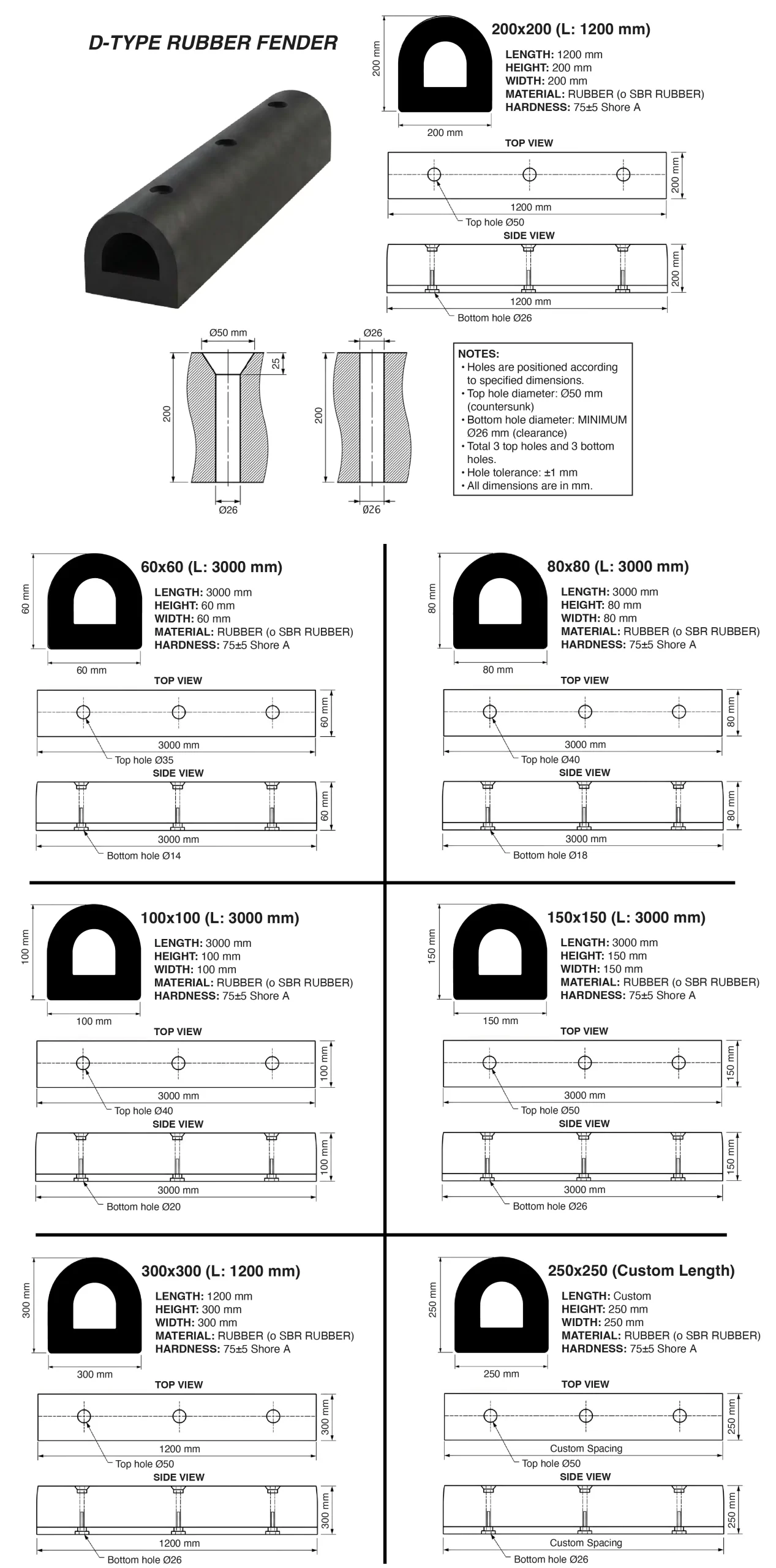
- Pre-Drilled Holes: Upper holes are drilled at Ø50 mm with a countersunk profile (for flush bolt head/washer mounting). Lower passage holes are drilled to a minimum of Ø26 mm (Hole tolerance: ±1 mm).
- Mitred Fender Jointing: Angled (mitred) corner cuts are applied to create continuous protection lines around quay and masonry corners.
- Corrosion-Resistant Fixing Kit: Marine-grade stainless steel or hot-dip galvanised bolts and fixing accessories are supplied upon request.
SKU and Standard Dimension Table
Explore our standard stock profiles and cross-sections in the table below:
| SKU Code | External Section (A x A) | Standard Length | Details & Application Notes |
|---|---|---|---|
| RSD60 | 60 x 60 mm | 3000 mm | Light craft and marina edges |
| RSD80 | 80 x 80 mm | 3000 mm | Standard stock profile |
| RSD100 | 100 x 100 mm | 3000 mm | For custom length requests: RS-FND-D-100-CST |
| RSD150 | 150 x 150 mm | 3000 mm | Medium-tonnage berthing lines |
| RSD200 | 200 x 200 mm | 2000 mm | Inner D: 120×120 mm, Base: 40 mm. (800 mm and 1200 mm drilled options available) |
| RSD250 | 250 x 250 mm | Custom / Project | Custom profile engineered for heavy-duty quays |
| RSD300 | 300 x 300 mm | 1200 mm | High-impact absorption for heavy commercial berths |
Material Mechanical Properties
Verified laboratory test data for our SBR rubber compound:
| Technical Parameter | Standard Value | Test Standard |
|---|---|---|
| Density | 1.60±0.05 g/cm3 | DIN 53515 |
| Hardness | 75±5 Shore A | ASTM D 2240 |
| Tensile Strength | ≥12 MPa | ASTM D 412 C |
| Elongation at Break | ≥250% | ISO 37 |
| Compression Set (22 hrs at 70°C) | ≤30% | ISO 815-1 |
| Compression Set (22 hrs at 100°C) | ≤40% | ISO 815-1 |
| Ozone Resistance (200 pphm, 48 hrs) | No Cracking | ISO 1431-1 Method A |
On-Site Layout and Installation Notes
Selecting the correct profile section depends on vessel displacement, approach speed, and freeboard height. While 60–100 mm profiles provide sufficient energy absorption for small boats and yacht marinas, profiles of 200 mm and above are recommended for commercial port quays.
For seamless corner protection, mitred fender cuts should be specified. On pre-drilled versions, ensuring precise alignment between bolt centres and the supporting substructure guarantees a long service life. All technical specifications and manufacturing standards are backed by Rubbersan quality assurance.