
Anchor bolts loosen. Baseplates creep. Concrete pads develop hairline cracks under compressors that ran smoothly last year. None of this is random. Consequently, it is the slow signature of dynamic fatigue and mechanical resonance, working against your equipment one cycle at a time.
Maintenance Chiefs know the pattern well. A pump assembly starts vibrating slightly off-axis. Within months, alignment drifts, mechanical seals wear early, and unplanned downtime becomes routine. The machine itself is rarely to blame. However, the real cause is almost always inadequate vibration isolation at the interface between equipment and structure.
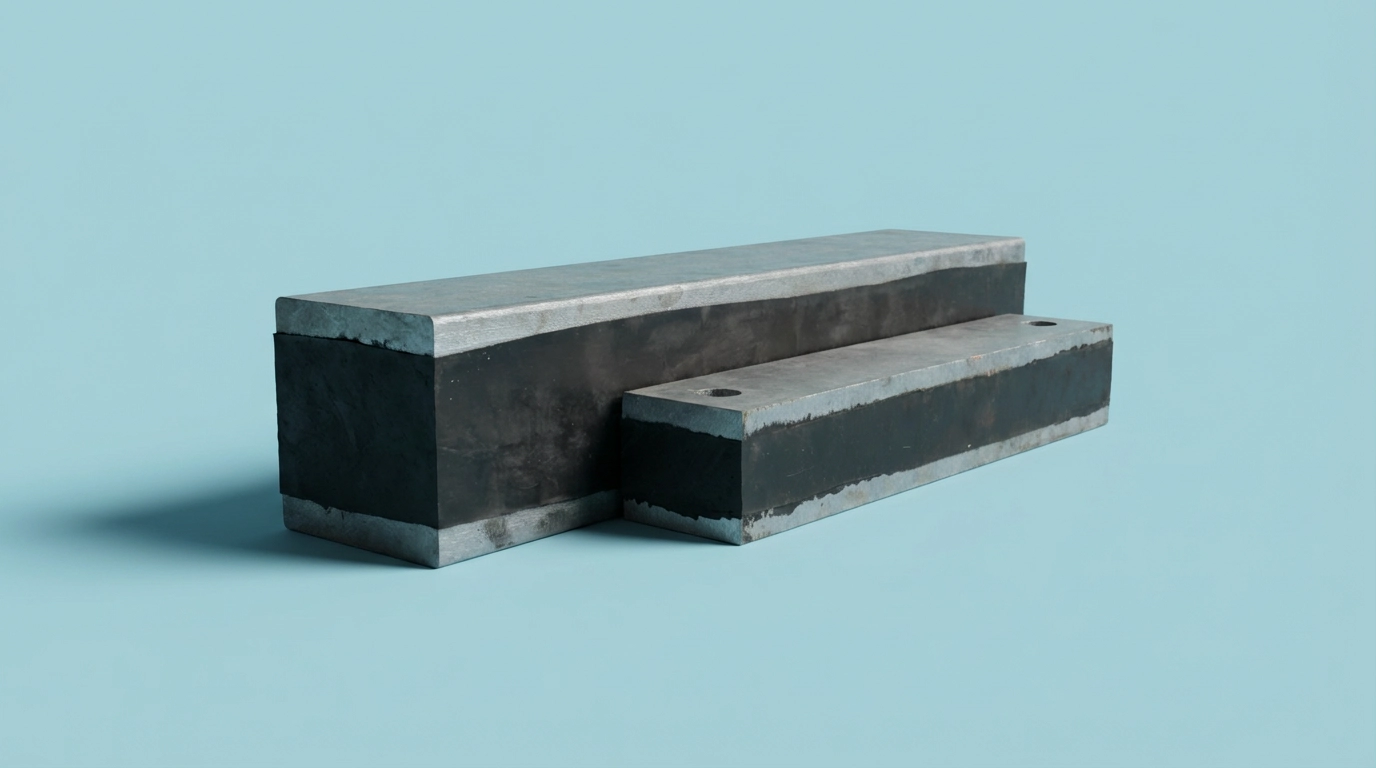
This is the operational gap that metal bonded rubber dampers are built to close. The industrial sandwich wedge, a rubber-to-metal vibration damper, handles forces that a standard isolation pad cannot sustain.
Why Standard Isolators Fall Short
Conventional rubber pads absorb vertical compression reasonably well. However, horizontal shear force is a different story. Heavy machinery rarely vibrates in one single plane. Cranes swing, pumps pulse, and generators produce torque reactions that push equipment sideways as well as down.
Horizontal dynamic force attenuation matters just as much as vertical cushioning. Without it, machinery walks across its foundation over time. Therefore, that lateral creep loosens fasteners, misaligns mechanical couplings, and wears bearings faster throughout the drivetrain.
How the Dual-Axis Damping Mechanism Works
A properly engineered sandwich wedge solves both dynamic force problems at once. Its construction uses a high-grade vulcanised rubber core bonded between two rigid metal load plates. That design performs two mechanical functions simultaneously.
The rubber core compresses vertically to absorb impact and static load. At the same time, the elastomer shears sideways to dissipate horizontal energy before it reaches the concrete foundation. As a result, the equipment stays isolated on both axes, not just one.
The metal plates do more than provide a mounting surface. They spread structural loads evenly across the rubber core and prevent localized crushing. Furthermore, the bonded interface removes mechanical play entirely, stopping the floor drift that plagues bolted-only installations.
Elastomer to Metal Bonding: The Interface That Decides Service Life
The bond between rubber and metal is usually the weakest point in an inferior damper. If adhesion fails under repeated load, the wedge delaminates and loses its damping capacity without warning.
Sound elastomer to metal bonding relies on chemical primers and controlled vulcanisation pressure. Done correctly, the bond ends up stronger than the rubber itself. For instance, the interface stops being the failure point, even after years of continuous cyclic stress.
Choosing the Right Elastomer Compound
No single rubber compound suits every industrial application. The right choice depends on temperature exposure, chemical contact, and abrasion at your plant site.
| Elastomer | Shore A Hardness | Temperature Range | Tensile Strength | Key Resistance |
|---|---|---|---|---|
| EPDM | 60–70 | -40°C to 120°C | 8–12 MPa | Weathering, ozone, UV |
| NBR | 65–75 | -30°C to 100°C | 10–15 MPa | Oil, fuel, hydrocarbons |
| SBR | 55–65 | -30°C to 90°C | 7–10 MPa | Abrasion, general wear |
| Neoprene | 60–70 | -35°C to 110°C | 9–14 MPa | All-round mechanical stability |
EPDM NBR sandwich mounts cover the two most common operational cases on a factory floor. EPDM suits outdoor installations exposed to weathering and ozone. NBR handles hydrocarbon exposure near pumps, compressors, and fuel-adjacent equipment. SBR gives reliable abrasion resistance in high-traffic mechanical zones. Neoprene offers steady, all-round performance where operating conditions vary.
Where These Dampers Earn Their Keep
Heavy machinery damping elements built this way are meant for continuous-duty industrial environments, including:
- Heavy machinery bases that require long-term anchor stability.
- Pump and crane assemblies carrying combined vertical and lateral loads.
- Generators producing torque-driven horizontal vibration.
- Compressors running at high cyclic frequencies.
- Electrical control panels that need isolation from structural resonance.
In each case, dual-axis damping keeps mechanical resonance from amplifying and damaging the underlying foundation.
Meeting Vibration Isolation Mounts EU Requirements
European facilities increasingly ask for documented compliance on vibration isolation mounts EU installations, often referenced against ASTM D2000 material classifications. This standard defines elastomer performance by hardness, tensile strength, and environmental resistance. Consequently, it gives engineers a verifiable basis for material selection instead of a guess.
Specifying compounds against ASTM D2000 also simplifies technical audits and safety reviews. It gives Civil and Mechanical Engineers a shared technical language when comparing suppliers across an international project.
Building a Complete Industrial Vibration Control Strategy
Sandwich wedges rarely work alone. A solid industrial vibration control strategy usually pairs them with other specialized rubber components across the facility.
For instance, installing high-grade industrial rubber sheeting underneath machinery beds adds surface protection and secondary vibration dampening, spreading residual load across a wider footprint. For transport and logistics zones, deploying heavy-duty industrial wheel chocks handles stationary force containment at loading docks, preventing unexpected vehicle rollback under load.
Furthermore, for sites facing extreme environmental exposure, heavy-duty aircraft wheel chocks and marine [quay wall fenders demonstrate how vulcanised rubber-to-metal engineering scales up. These solutions confirm that bonded rubber technology holds up reliably from factory floors to airport runways and port terminals.
Specifying Your Damping Solution
The right sandwich wedge configuration depends on load rating, shear direction, and chemical exposure at your facility. Guessing at compound selection adds operational risk and shortens component service life.
Before your next equipment installation or retrofit, request custom engineering drawings and material data sheets matched to your actual dynamic load profile. Our technical team also handles custom compounding requests for applications outside standard EPDM, NBR, SBR, or neoprene specifications, ensuring your equipment gets isolation engineered for real operating conditions.