
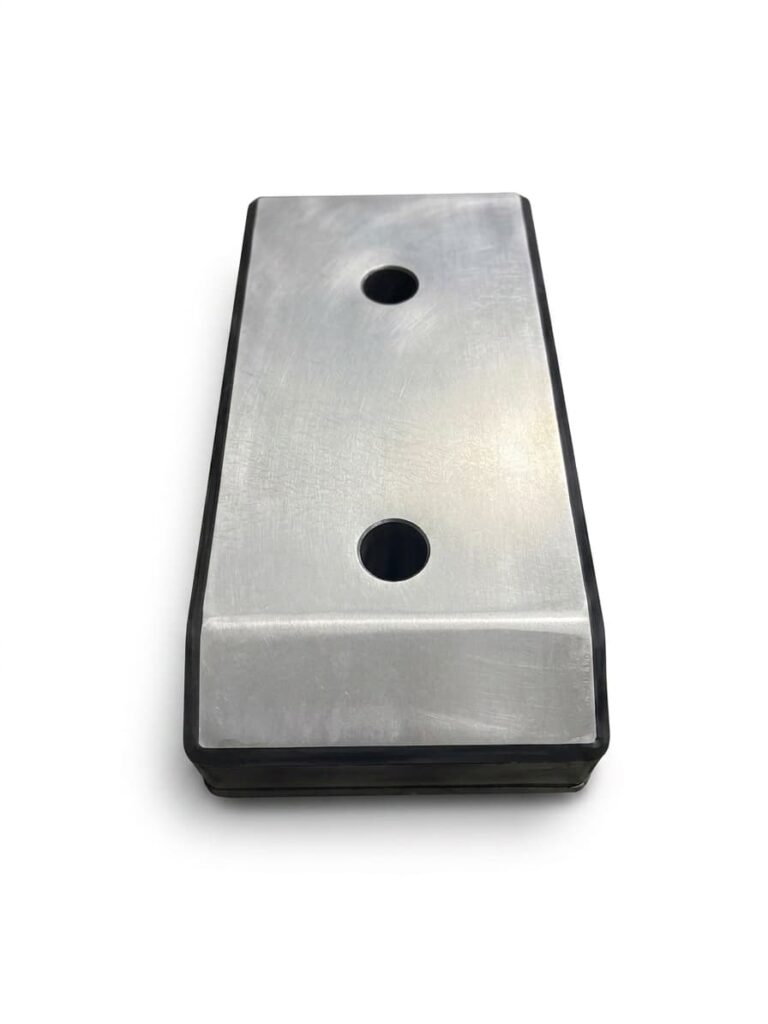
The rubber dock bumper is a heavy-duty protection component designed to absorb impact and contact forces when lorries and trucks reverse into loading bays, warehouses, and industrial facilities. Featuring a 100 mm thick elastomeric rubber core reinforced with 10 mm thick steel plates on both the top and bottom surfaces, it provides a resilient rubber-steel hybrid structure. Its 250 mm width and 500 mm height ensure an optimal contact area for standard truck and commercial vehicle chassis geometries.
As an essential loading bay protection element, it serves as a shock-absorbing interface between the concrete dock structure, steel framework, and vehicle bodies. Classified as a heavy-duty loading dock bumper, this product is manufactured for continuous, high-frequency use in high-traffic logistics environments.
Primary Applications
- Logistics Centres: Capable of handling repeated daily docking impact loads across multiple bay doors.
- E-Commerce Distribution Depots: Built to withstand frequent vehicle turnover during intensive shift operations.
- Manufacturing Loading Bays: Suited to regular goods sirkulation during raw material and finished product transport.
- Cold Storage Depots: Maintains core elasticity and shock absorption performance at sub-zero temperatures.
- Lorry Terminals: Ideal as a heavy-duty truck dock bumper in high-manoeuvring transport hubs.
- Port & Maritime Facilities: Resistant to humid and marine environments along quay and ramp lines.
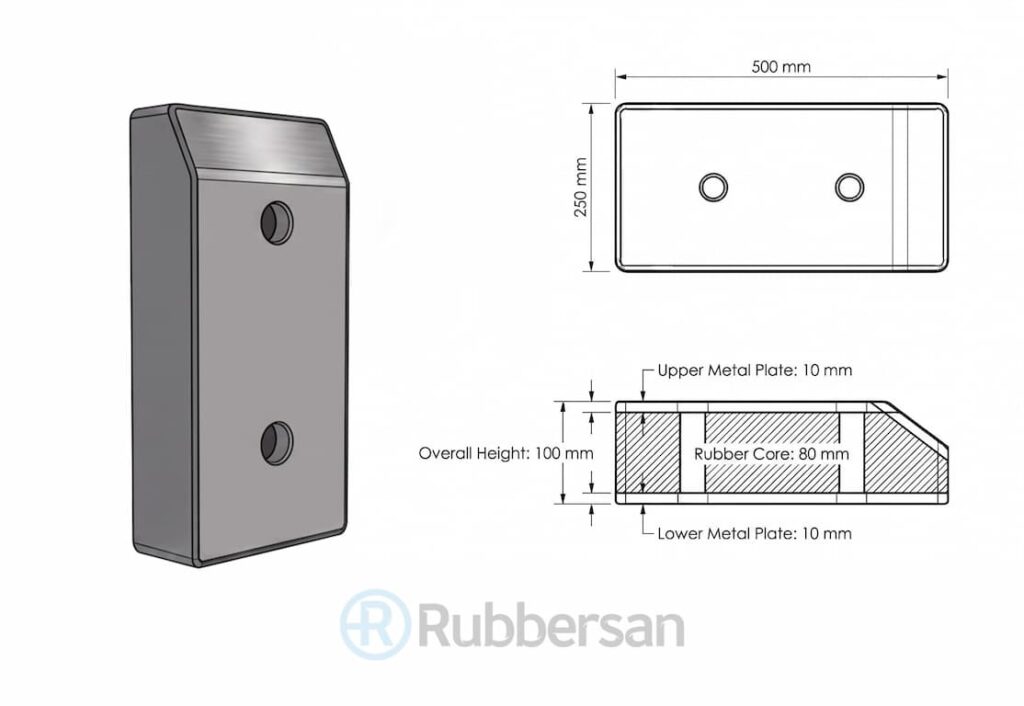
Structural and Technical Features
- Rubber Core: 100 mm thick high-density elastomeric rubber compound.
- Steel Reinforcement: 10 mm thick steel plates bonded to the top and bottom surfaces.
- Dimensions: 100 × 250 × 500 mm (depth × width × height).
- Structure Type: Rubber-steel hybrid shock absorption system.
- Bonding: Vulcanisation and mechanical fastening reinforce the rubber-to-metal interface.
- Function: Absorbs kinetic energy upon impact and dissipates it evenly across the mounting surface.
Operational Benefits
- Minimises the risk of cracking, chipping, and spalling on concrete dock edges.
- Reduces fatigue and structural bending in steel frame loading bay connections.
- Prevents repetitive impact damage to the rear bodywork of reversing lorries.
- Delivers an extended service life due to its armoured steel plate design.
- Reduces long-term maintenance costs and bumper replacement frequency.
- Retains structural integrity across a wide range of operating temperatures.
Technical Specifications Table
| Parameter | Specification / Description |
|---|---|
| Product Name | Heavy-Duty Rubber Dock Bumper (Rubber Loading Dock Bumper) |
| Body Depth | 100 mm |
| Width | 250 mm |
| Height / Length | 500 mm |
| Core Material | Elastomeric rubber (100 mm thickness) |
| Structural Reinforcement | 10 mm thick steel/metal plates (top and bottom) |
| Structure Type | Rubber-Metal Hybrid Construction |
| Primary Function | Impact absorption and energy dissipation |
| Mounting Surface | Concrete loading bay, structural steel frame |
| Protected Elements | Vehicle bodywork, loading dock infrastructure |
| Application Areas | Logistics parks, e-commerce depots, factories, cold stores, lorry terminals, port facilities |
| Product Class | Heavy-duty loading dock bumper |
| UK English Terminology | Rubber dock bumper, loading bay bumper, lorry dock bumper |
Installation and Application Notes
The dock bumper is secured to the dock face using heavy-duty anchor bolts or fasteners. The pre-drilled mounting hole positions on the steel plates should be verified against the loading bay structure prior to installation. Proper mounting height must align with the average vehicle chassis contact point, ensuring impact energy is transferred directly into the rubber core. For high-traffic loading bays, maintaining equal spacing between multiple bumpers ensures uniform load distribution. This product is manufactured by Rubbersan.