
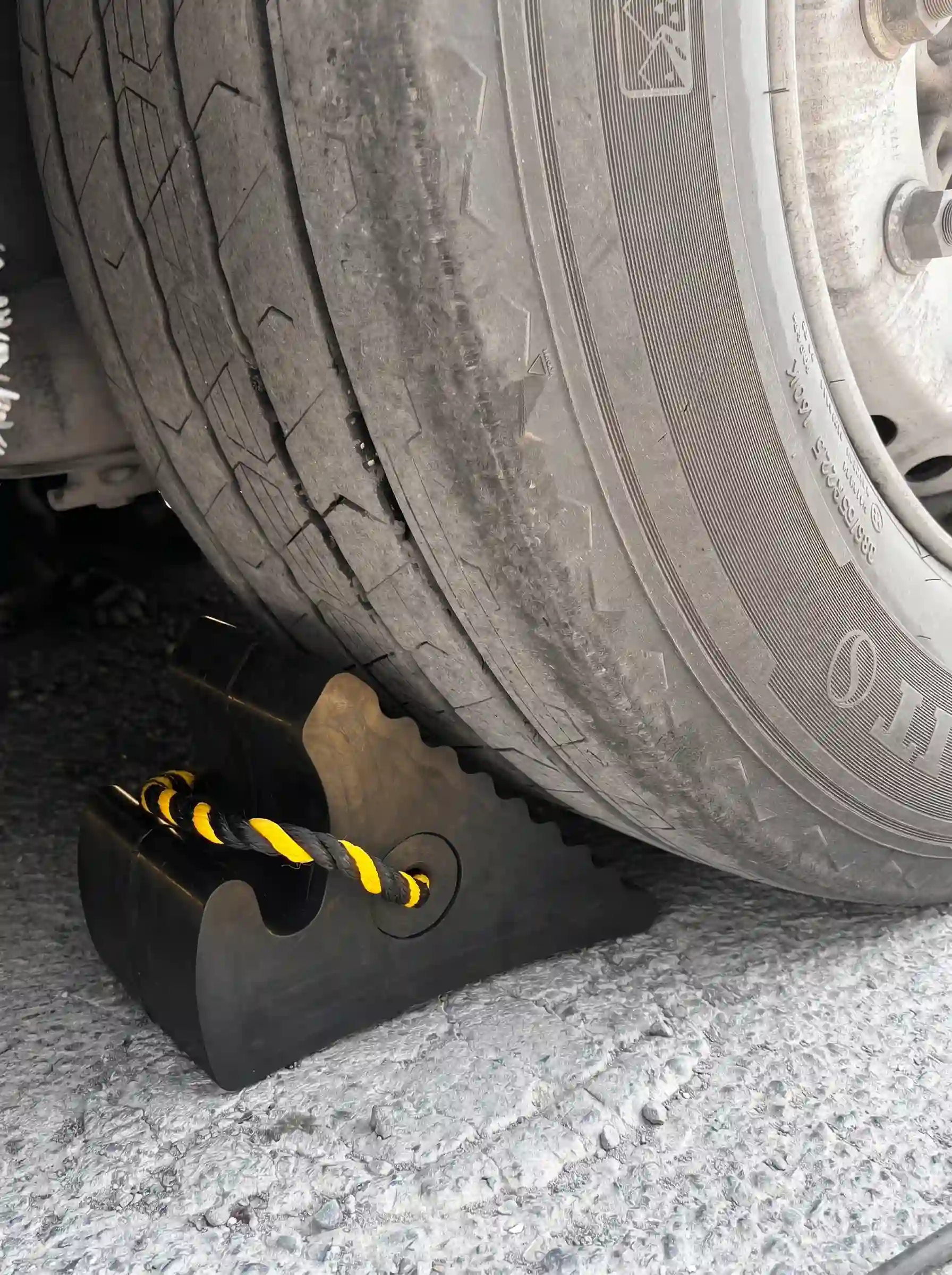
Infrastructure damage in logistics hubs isn’t an accident; it’s a design flaw. Bent dock levellers and sheared bollards are the expensive side effects of under-specified parking restraints. When a wheel stopper isn’t engineered for the actual load, the concrete substrate and the vehicle pays the price.
Selecting the right restraint demands precision. This technical guide outlines the exact dimensions required for different vehicle classes, details how material properties dictate field performance, and defines what must be in a purchase order to ensure safety compliance and a defensible total cost of ownership.
Why Rubber? The Material Case
The most common procurement debate worth settling upfront is rubber vs concrete wheel stopper load capacity.
Precast concrete blocks remain the default choice for light-commercial yards because they are inexpensive. In heavy-duty logistics and industrial warehouse environments, however, rubber compounds consistently outperform concrete. This superior performance directly drives down long-term operational costs.
Comparison: Vulcanised Rubber vs. Precast Concrete
| Property | Vulcanised Rubber | Precast Concrete |
| Impact Energy Absorption | High elastic deformation. | Low; high brittle fracture risk. |
| Tyre Abrasion Damage | Negligible. | Moderate to high. |
| Weather Resistance | Excellent UV protection. | Good; surface degradation over time. |
| Oil & Chemical Resistance | Excellent compound resistance. | Poor; surface spalling occurs. |
| Replacement Frequency | Long-term durability. | Frequent replacement needed. |
| Anchor Bolt Retention | Superior; flex dampens forces. | Inferior; cyclic impact cracks substrate. |
The single most important variable is compound hardness. For heavy duty wheel stoppers, the material must absorb elastic energy efficiently. This flexibility protects both the vehicle tyre and the concrete fixing substrate from cracking over time.
Rubber Wheel Stopper Dimensions: Standard Ranges by Vehicle Class
Generic supplier catalogues often fail because “commercial vehicle” is not a precise specification. A transit van and a three-axle tipper impose entirely different kinetic loads. Therefore, the dimensional ranges below reflect standard engineering practices across three distinct vehicle categories.
1. Light Commercial Vehicles
This category includes retail distribution yards and light industrial units. A smaller-profile stopper is appropriate here.
- Length Range: 900 mm – 1,200 mm
- Width Range: 100 mm – 150 mm
- Height Range: 80 mm – 100 mm
2. Medium Commercial Vehicles
This band covers delivery rigids, buses, and refuse collection vehicles. These vehicles typically run on standard commercial tyre profiles.
- Length Range: 1,200 mm – 1,500 mm
- Width Range: 150 mm – 180 mm
- Height Range: 100 mm – 130 mm
3. Heavy-Duty Vehicles
This is the critical band where specification errors cause major safety incidents. Articulated lorries, heavy plant transporters, and port handling machinery all fall here. Therefore, choosing the correct commercial wheel stopper size is a safety priority.
- Length Range: 1,500 mm – 2,000 mm
- Width Range: 180 mm – 220 mm
- Height Range: 140 mm – 200 mm
- Visibility: High-visibility yellow retroreflective strips are strongly recommended.
How High Should a Truck Wheel Stopper Be?
The answer depends entirely on tyre section height. This requires clarity because the question how high should a truck wheel stopper be? is often answered imprecisely.
The governing principle is straightforward. The stopper must engage the tyre below the wheel centre line. This contact generates a stable resistive moment. Especially relevant is that if the stopper height exceeds the wheel centre, the vehicle can ride over the block.
- Standard HGV Tyres: A common long-haul truck tyre places the wheel centre at approximately 522 mm above ground. Therefore, a truck wheel stopper height of 150–200 mm keeps contact firmly in the lower quarter of the tyre.
- Wide-Base Tyres: Super-single wide-base tyres have a shallower section height. Consequently, a 130–160 mm stopper height is more appropriate.
- Special Environments: Airport and port environments introduce further complications due to varying vehicle types. For this reason, always cross-reference the site’s specific vehicle tyre schedule before purchasing.
Standards and Compliance for Heavy-Duty Applications
Engineers specifying heavy duty parking curb specifications for European facilities must map requirements against key regulations:
- Road Restraint Principles: National highway authorities frequently reference vehicle restraint geometry principles when reviewing facility access layouts.
- Visual Demarcation: Modern accessibility standards mandate clear visual demarcation of stopping zones wherever personnel or drivers have access.
- Specialized Zones: In petrochemical and explosive-risk environments, stoppers must be verified non-static-generating. Always confirm compound resistivity on the technical data sheet.
- Loading Bays: For standard dimensions for commercial vehicle parking blocks in loading bay applications, logistics hubs increasingly reference docking interface guidelines. These guidelines tie minimum restraint dimensions directly to dock platform height.
The Cost of Ownership Argument
Unit purchase price is the least useful number in this procurement decision. What truly matters is the long-term cost across a full complement of installed stoppers.
Consider a typical 50-bay heavy vehicle logistics facility over a ten-year period:
- Standard Concrete Blocks: Concrete parking blocks have a low initial unit cost. However, they suffer a high replacement cycle under heavy loading. Furthermore, labor costs to remove and reinstall them accumulate quickly. Substrate cracking around anchor points adds significant repair expenses.
- Heavy-Duty Rubber Stoppers: High-quality rubber units have a higher initial price. Nevertheless, their replacement cycle is drastically longer because rubber recovers elastically under repeated contact. Installation happens once, and substrate repair costs become negligible.
In conclusion, investing in correct rubber dimensions delivers a massive reduction in total cost of ownership. This calculation does not even factor in operational downtime or vehicle impact incidents.
What a Proper Purchase Order Should Specify
A vague description will not get you the right product. A technically adequate purchase order for industrial restraints should explicitly specify the following parameters:
- Material Compound Type: High-grade vulcanised rubber compound.
- Hardness and Tensile Strength: Optimal Shore A hardness for heavy vehicle load rating.
- Environmental Resistance: Certified UV, ozone, and extreme temperature operational range.
- Dimensional Tolerances: Clear length, width, and height boundaries.
- Fixing Hardware: Anchor bolt specification matched to your asphalt or concrete substrate.
- Reflective Elements: Integrated retroreflective inserts for low-light visibility.
The Specification Advantage
The gap between a wheel stopper that holds and one that fails is almost always a specification gap. Get the compound, the geometry, and the fixing right from the outset. Consequently, these products will quietly do their job for a decade or more.
If you are sourcing equipment for a logistics facility, an industrial warehouse, or a construction project, the conversation ought to begin with your vehicle schedule.