
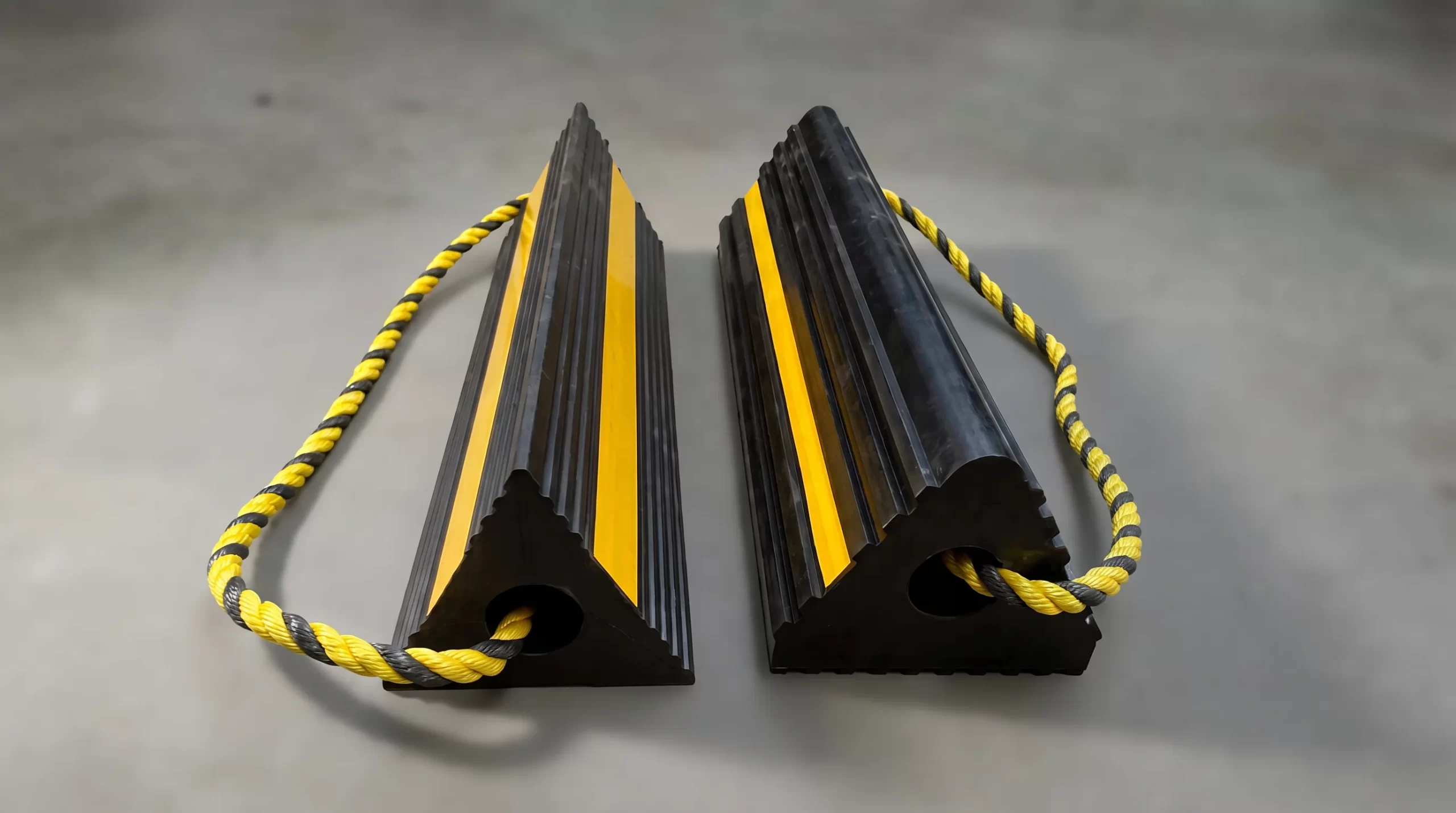
Airside safety often depends on the smallest pieces of infrastructure doing their job flawlessly. Aircraft chocks may be relatively simple devices, but they perform a critical safety function every time an aircraft is parked, serviced, loaded, refuelled, or left unattended on the apron.
Historically, timber chocks were commonplace throughout the aviation industry due to low upfront costs. However, the demands placed upon modern airport ground support equipment today are vastly different from previous decades. Higher aircraft utilisation rates, stricter safety regulations, and increasingly rigorous Foreign Object Debris (FOD) management programmes have highlighted critical mechanical shortcomings associated with wooden chocks.
Timber rapidly deteriorates when exposed to moisture, ultraviolet radiation, aviation fuels, hydraulic fluids, and repeated heavy loading cycles. As it ages, it splits, cracks, and fragments—creating hazardous debris that has no place on an active airfield. Even a seemingly minor material defect can become a catastrophic safety concern when operating around aircraft worth hundreds of millions of pounds.
For airport operators, maintenance organisations, and ground handling companies, the transition to high-performance rubber airplane chocks is no longer just a preference, but an operational and regulatory necessity.
1. The Mechanical Limitations of Timber in Airside Environments
Timber performs adequately when brand new, but wood offers virtually zero chemical resistance to an unforgiving aircraft apron environment. Chocks are routinely subjected to rain, standing water, extreme temperature fluctuations, and constant contamination from aviation fuels and hydraulic oils.
Over time, structural timber deterioration becomes completely unavoidable, leading to:
- Surface Cracking & Splitting: Compromising structural load distribution.
- Water Absorption & Swelling: Causing severe distortion during wet-dry cycles.
- Rot & Biological Degradation: Weakening the internal grain structure of the chock.
- Edge Breakage & Chipping: Generating immediate loose debris on the tarmac.
A cracked wooden chock fails to maintain consistent contact with either the tyre or the pavement surface, introducing dangerous uncertainty. Conversely, industrial aviation wheel chocks manufactured from vulcanised elastomer compounds retain their exact shape, flexibility, and mechanical properties throughout their entire service life, eliminating ongoing replacement and continuous maintenance oversight.
2. Superior Grip and Friction Performance Under Extreme Aircraft Loads
The fundamental engineering purpose of any aircraft chock is straightforward: prevent unintended aircraft movement. Effective wheel restraint depends heavily on the coefficient of friction achieved between the chock, the tyre, and the pavement beneath.
This is where rubber airplane chocks provide a definitive physical advantage. Unlike timber, which relies solely on its dead weight and rigid shape, rubber combines mechanical restraint with a naturally high coefficient of friction. The elastomeric matrix conforms slightly under pressure to both the tyre tread and the concrete apron, creating an incredibly secure, non-slip interface.
This reliable friction performance is vital across all fleet sectors:
- Narrow-body commercial aircraft & wide-body passenger liners.
- High-volume cargo fleets and military aircraft.
- Business jets parked on sloped airfield stands.
During demanding winter ramp operations, surfaces are heavily compromised by rain, ice, frost, and de-icing fluids. To combat this, modern heavy duty aircraft chocks are engineered with high-friction contact faces, anti-slip base geometries, and tyre-conforming profiles. This ensures the chock remains locked in place during active refuelling, luggage loading, and extended parking periods.
3. Eliminating FOD Hazards to Support Aviation Safety Compliance
Few hazards receive as much operational attention within aerodromes as Foreign Object Debris (FOD). A single loose fragment of material on an active apron can cause catastrophic tyre blowouts, airframe damage, or multi-million-pound engine ingestion incidents.
Aged timber chocks are a notorious and completely avoidable source of FOD on the ramp. As wood degrades under structural loading, it continuously sheds:
- Sharp splinters and loose wooden fragments.
- Cracked sections and detached corners.
- Abrasive surface chips.
Transitioning to high-grade aircraft wheel chocks manufactured from reinforced rubber blends entirely eliminates this risk. Premium elastomer compounds do not splinter, shatter, or fragment under high impact or heavy compression. For aviation hubs operating under rigid aviation safety compliance programmes, removing timber from the tarmac is a massive step forward in proactive risk reduction.
4. Durability, Weather Resistance, and Long-Term Elastomer Performance
The long-term resilience of a rubber vs wood chocks setup comes down to chemical engineering. Modern airfield chocks are mixed from compound polymers specifically chosen for punishing outdoor industrial environments:
- SBR (Styrene-Butadiene Rubber): Selected for its outstanding abrasion resistance, high impact resilience, and reliable performance under repeated structural cycles.
- EPDM (Ethylene Propylene Diene Monomer): Integrated to provide exceptional UV and ozone resistance, ensuring the compound remains flexible without dry-rotting in extreme heat or freezing conditions.
Typical Technical Specifications Include:
- Thermal Operating Range: Stable performance from -40°C up to +80°C.
- Fluid Resistance: High immunity to moisture ingress, jet fuels, and Skydrol hydraulic fluids.
- Ergonomic Enhancements: Integrated high-visibility yellow safety strips, reflective markings, and heavy-duty embedded carrying ropes or handles for ground crews.
5. Lower Replacement Rates and Reduced Total Cost of Ownership (TCO)
While timber chocks traditionally attract procurement teams due to their cheap initial purchase price, a true lifecycle cost analysis tells a very different financial story.
When evaluating the financial footprint of airport equipment, procurement teams must factor in the total operational costs:
| Operational Parameter | Traditional Timber Chocks | Heavy-Duty Rubber Chocks |
| Service Life Expectancy | Extremely short (Months) | Outstandingly long (Years) |
| Inspection Frequency | Highly frequent (Risk of splitting) | Minimal routine safety checks |
| Debris & FOD Risk | High liability (Splintering wood) | Zero risk (Solid structural rubber) |
| Environmental Storage | Low resistance to water and rot | Total immunity to weathering/UV |
| Long-Term Procurement TCO | High due to constant replacement cycles | Highly cost-effective long-term investment |
For large commercial airports and international ground handling organizations managing hundreds of stands, the frequent labor and disposal costs of timber quickly add up. Rubber chocks deliver a significantly lower Total Cost of Ownership by outlasting wood by multiple operational lifecycles.
Conclusion: Engineering Safer Airside Operations
The gradual shift away from timber chocks reflects decades of international airfield experience and a modern emphasis on safety, reliability, and corporate risk mitigation. Compared to wood, rubber chocks offer superior traction, absolute weather resilience, and zero risk of generating dangerous Foreign Object Debris.
Investing in engineered rubber ground support components ensures your facility satisfies modern airfield safety metrics while optimizing long-term procurement budgets.
Consult Our Aviation Ground Safety Specialists
Selecting the appropriate chock configuration requires matching specific fleet wheel geometries, weight distributions, and apron conditions. Our engineering and sales department can assist your team with:
- Commercial, cargo, and military aircraft fleet setups.
- Custom dimensions, load ratings, and high-visibility safety configurations.
- Technical Data Sheets (TDS) and bulk procurement programmes.
Contact our team to discuss your airfield requirements, request full technical documentation, or obtain a tailored commercial quotation.